



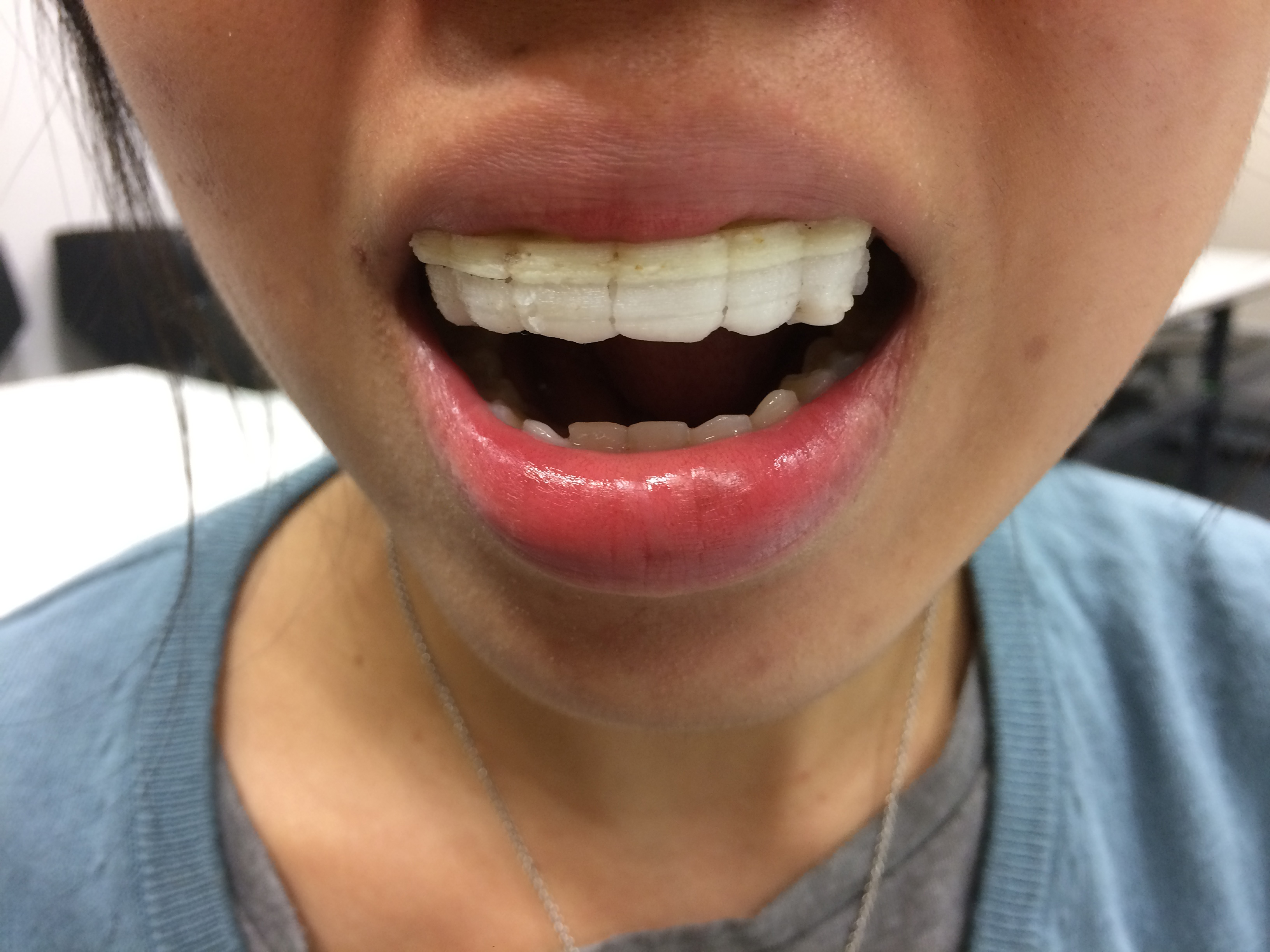
A research team headed by Jean-Christophe Leroux from ETH Zurüch has created the first-ever 3-D printed mouth guard that could deliver drugs to the wearer and is highly customizable, in terms of drug release and design.
3-D printing holds great promise for the pharmaceutical field where it could allow personalized drug delivery systems to be efficiently created, featuring controllable drug release patterns not currently possible to fight i.e. oral inflammations. To date, only single or combinations of multiple drugs have been used in 3-D printing-related efforts to deliver drugs which the authors believe is a mere fraction of this technique’s potential.
Applying a two-step fabrication process, first author Kun Liang et al. used 3-D printing to create a structure that is particularly customizable based on tooth impressions, for drug delivery for oral diseases. In an in vitro test, they evaluated it with clobetasol propionate, an anti-inflammatory corticosteroid alleviating oral inflammation; it was released reliably over two weeks. In a Phase I study in six human volunteers, the drug was replaced with the flavor substitute vanillic acid. Wearers tested different vanilla-infused mouth guard prototypes for two hour-periods over three consecutive days; delivery was also sustained, the researchers report.
The mouth guard achieves its highly controlled release through a design that varies the polymer composition to produce special, sensitive filaments. The entire process of printing it for use in human volunteers took two hours, say the authors, which is notably faster than traditional casting and molding techniques for standard mouth guards. This 3-D printing fabrication process can be applied to other devices, the authors say.